
Tradicionalmente, el desarrollo económico de los países se ha medido a través de indicadores como el Producto Interno Bruto (PIB), que reflejan la producción de bienes y servicios, pero que no capturan adecuadamente el valor de los recursos naturales ni los costos asociados a su degradación. Como resultado, actividades que generan crecimiento económico pueden, al mismo tiempo, reducir el capital natural del país sin que esta pérdida sea visible en las estadísticas económicas.
Medir el valor de la naturaleza e integrarlo en las cuentas nacionales permite reconocer que los ecosistemas, la biodiversidad, el agua, los bosques, los suelos y otros recursos naturales constituyen activos estratégicos que sustentan el bienestar social, la productividad y la competitividad económica. Estos activos proporcionan servicios ecosistémicos esenciales, como la regulación del clima, la provisión de agua, la fertilidad del suelo, la captura de carbono y la protección frente a desastres naturales.
La información sobre el valor de la naturaleza y su contribución a la economía puede consultarse a nivel mundial a través de EBI-Ecosimple, a través del tablero de control Natural Capital Accounting.
Lo que América Latina ya está realizando en cuentas ambientales
Actualmente, el tablero de control reúne 81 cuentas de capital natural correspondientes a 22 países alrededor del mundo.
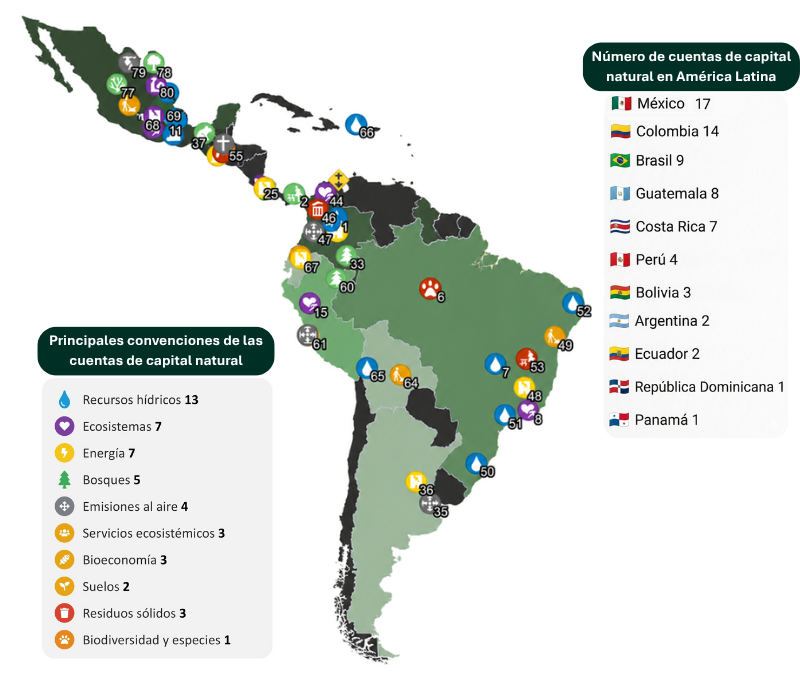
No es solo un mapa con datos: es una forma distinta de mirar y decidir sobre el territorio.
- Haz visible lo que importa: Reconoce el valor de los ecosistemas y recursos naturales y llévalo a las conversaciones donde se toman decisiones.
- Decide con evidencia: Consulta qué han medido otros países, encuentra antecedentes y evita empezar de cero.
- Encuentra oportunidades: Identifica vacíos temáticos y territoriales que pueden orientar nuevas investigaciones, proyectos o iniciativas.
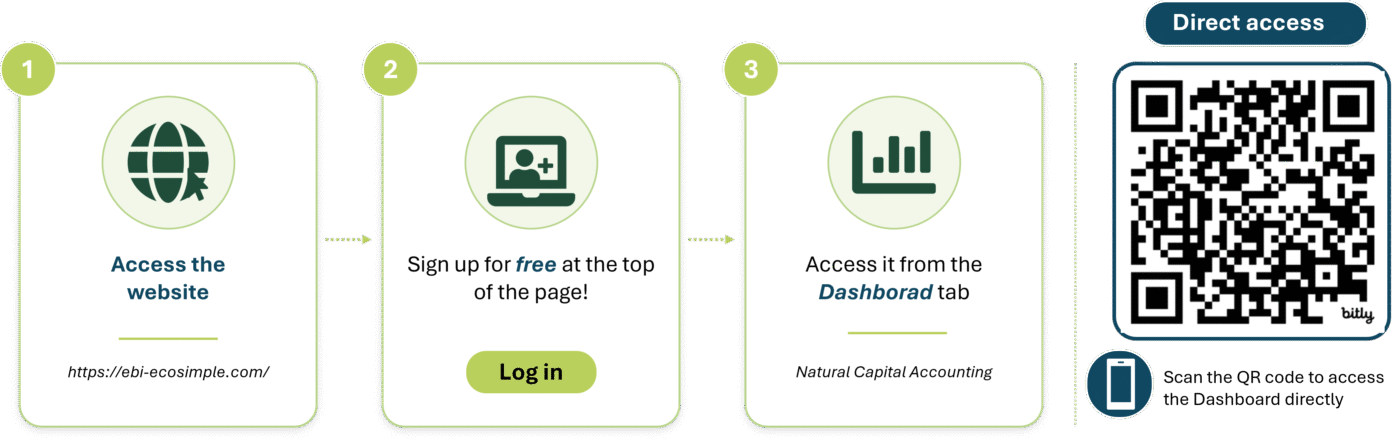
Llega al tablero en 3 pasos, sin costo
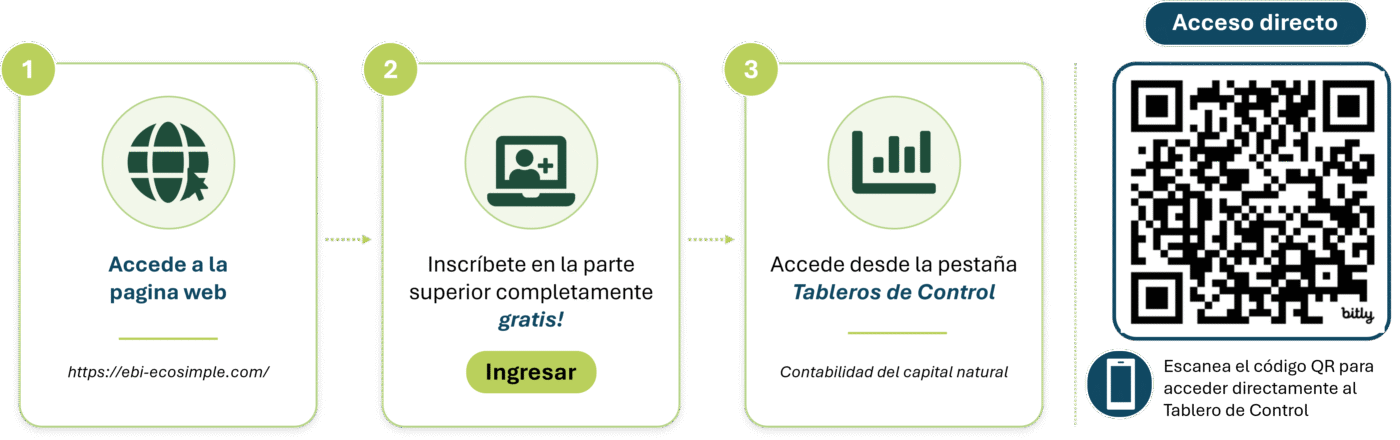
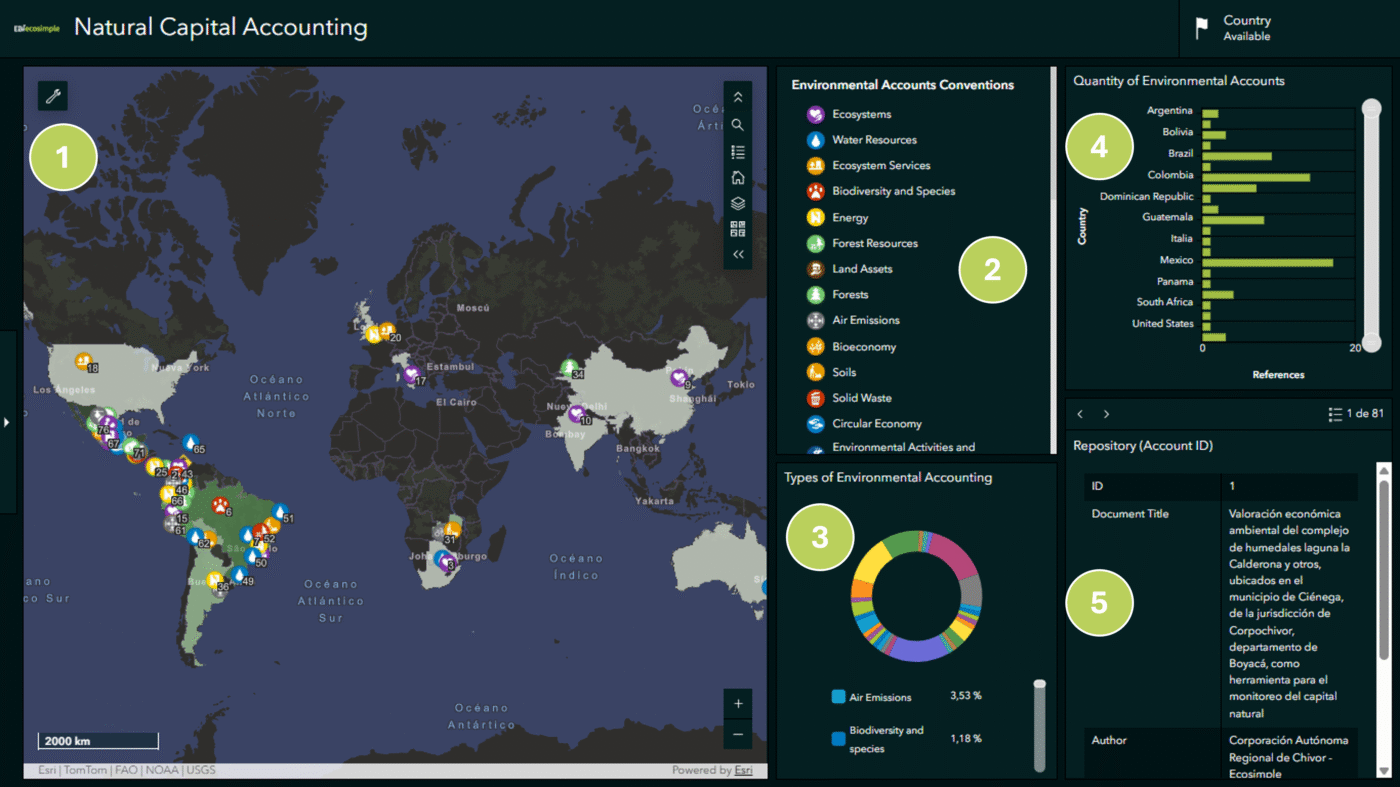
Ahora, recorre el tablero en 5 pasos
Encuentra en la imagen los siguientes pasos
Paso 1. El mapa: ¿dónde?
Cada marcador representa una cuenta ambiental. Su ícono indica el tipo de cuenta y su número corresponde al ID del repositorio.
⇒ Usa la lupa para buscar un lugar, + y – para acercarte o alejarte, y haz clic sobre los marcadores para consultar más información.
Paso 2. Las convenciones: ¿qué tipo y cuántas?
Ya sabes dónde están las cuentas; en la leyenda:
- “Environmental Accounts Conventions” para reconocer que ícono y color representa cada tipo de cuenta.
- “Accounts by Country” representa la cantidad de cuentas registradas mediante una escala de color. Los tonos más intensos corresponden a un mayor número de cuentas.
Paso 3. Tipos de contabilidad: ¿sobre qué?
El gráfico circular “Types of Environmental Accounting” convierte esos íconos en proporciones: muestra qué porcentaje del total corresponde a cada tipo de cuenta. Si filtraste un país, el gráfico te muestra el perfil temático de ese país.
Paso 4. Cantidad por país: cuánto ha avanzado cada país
El gráfico “Quantity of Environmental Accounts” pone en números lo que el mapa mostraba con marcadores: una barra por país, cuyo largo es el número de cuentas registradas.
Paso 5. El repositorio: el detalle de cada cuenta
El recorrido termina en el documento concreto. El panel “Repository (Account ID)” es la biblioteca del tablero: una ficha por cuenta, con enlace directo al documento original.
⇒ Consulta sus datos, utiliza las flechas < y > para recorrer los registros
Lo que antes tomaba horas de búsqueda, ahora está a pocos clics.
Lo que logras con EBI, y lo que construimos juntos
- Fortalece tus propuestas: cita antecedentes y demuestra el vacío que atiendes.
- Enseña con casos reales: muestra experiencias cercanas al territorio de tu audiencia.
- Mantente al día: el repositorio crece con nuevas cuentas y experiencias.
- Comparte con tu equipo y aliados: que todos decidan desde la misma evidencia.
Haz crecer el conocimiento disponible
¿Conoces una cuenta ambiental que todavía no aparece? ¿Encontraste un dato que necesita actualizarse?
Compártelo con nosotros aquí: innovacion@ecosimple.co
Cada aporte le da visibilidad a tu trabajo ante autoridades, investigadores y financiadores. También ayuda a que otra institución encuentre justo el antecedente que buscaba.
Súmate a quienes están haciendo visible el valor de la naturaleza en el mundo.
Do you know how to access natural capital accounts through EBI-Ecosimple?
Traditionally, countries’ economic development has been measured through indicators such as Gross Domestic Product (GDP), which reflect the production of goods and services but do not adequately capture the value of natural resources or the costs associated with their degradation. As a result, activities that generate economic growth may simultaneously reduce a country’s natural capital without this loss being reflected in economic statistics.
Measuring the value of nature and integrating it into national accounts makes it possible to recognize that ecosystems, biodiversity, water, forests, soils, and other natural resources are strategic assets that support social well-being, productivity, and economic competitiveness. These assets provide essential ecosystem services, such as climate regulation, water provision, soil fertility, carbon sequestration, and protection against natural disasters.
Information on the value of nature and its contribution to the economy can be accessed worldwide through EBI-Ecosimple, using the Natural Capital Accounting dashboard.
What Latin America is already doing in environmental accounting
Currently, the dashboard brings together 81 natural capital accounts from 22 countries around the world.
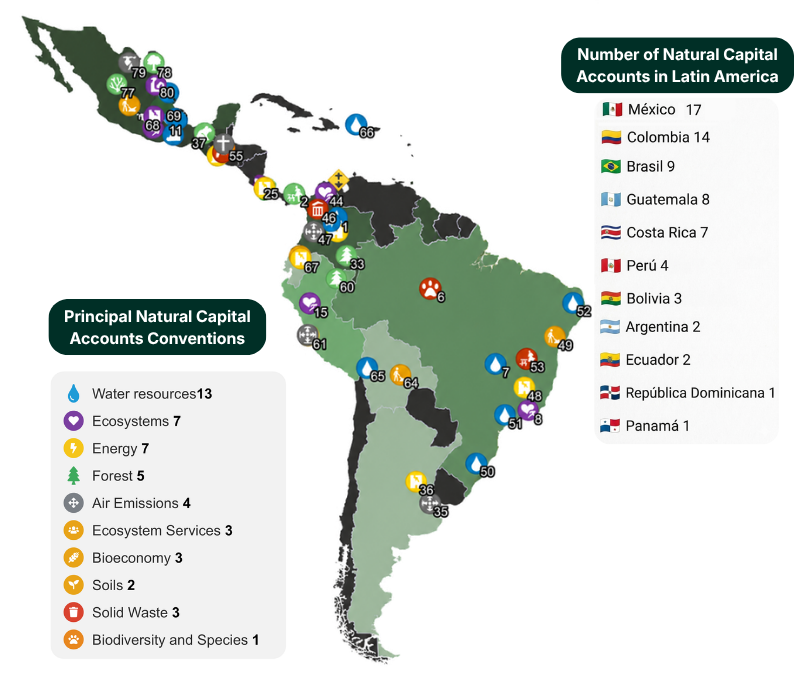
It is not just a map with data: it is a different way of understanding and making decisions about the territory.
- Make what matters visible: Recognize the value of ecosystems and natural resources and bring it into the conversations where decisions are made.
- Make evidence-based decisions: Explore what other countries have measured, find relevant precedents, and avoid starting from scratch.
- Identify opportunities: Identify thematic and geographic gaps that can guide new research, projects, or initiatives.
Access the dashboard in 3 steps, at no cost.
Now, explore the dashboard in 5 steps
Find the next steps in the image
Step 1. The map: Where?
Each marker represents an environmental account. Its icon indicates the type of account, and its number corresponds to the repository ID.
⇒ Use the magnifying glass to search for a location, + and – to zoom in or out, and click on the markers to view more information.
Step 2. The conventions: What type and how many?
You already know where the accounts are. In the legend:
- “Environmental Accounts Conventions” helps you identify which icon and color represent each type of account.
- “Accounts by Country” shows the number of registered accounts using a color scale. More intense shades correspond to a higher number of accounts.
Step 3. Types of accounting: What is being measured?
The “Types of Environmental Accounting” pie chart turns those icons into proportions: it shows what percentage of the total corresponds to each type of account. If you filter by country, the chart shows that country’s thematic profile.
Step 4. Number by country: How much progress has each country made?
The “Quantity of Environmental Accounts” chart puts into numbers what the map showed with markers: one bar per country, with its length representing the number of registered accounts.
Step 5. The repository: The details of each account
The journey ends with the specific document. The “Repository (Account ID)” panel is the dashboard’s library: one record for each account, with a direct link to the original document.
⇒ Review the account details and use the < and > arrows to browse through the records.
What used to take hours of searching is now just a few clicks away.
What you can achieve with EBI—and what we build together
- Strengthen your proposals: Cite precedents and demonstrate the gap your work addresses.
- Teach with real cases: Showcase experiences that are relevant to your audience’s territory.
- Stay up to date: The repository continues to grow with new accounts and experiences.
- Share with your team and partners: Ensure everyone makes decisions based on the same evidence.
Help expand the knowledge available
Do you know of an environmental account that is not yet included? Have you found information that needs to be updated?
Share it with us here: innovacion@ecosimple.co
Every contribution gives visibility to your work among policymakers, researchers, and funders. It also helps another institution find exactly the precedent it was looking for.
Join those making the value of nature visible across the world.